
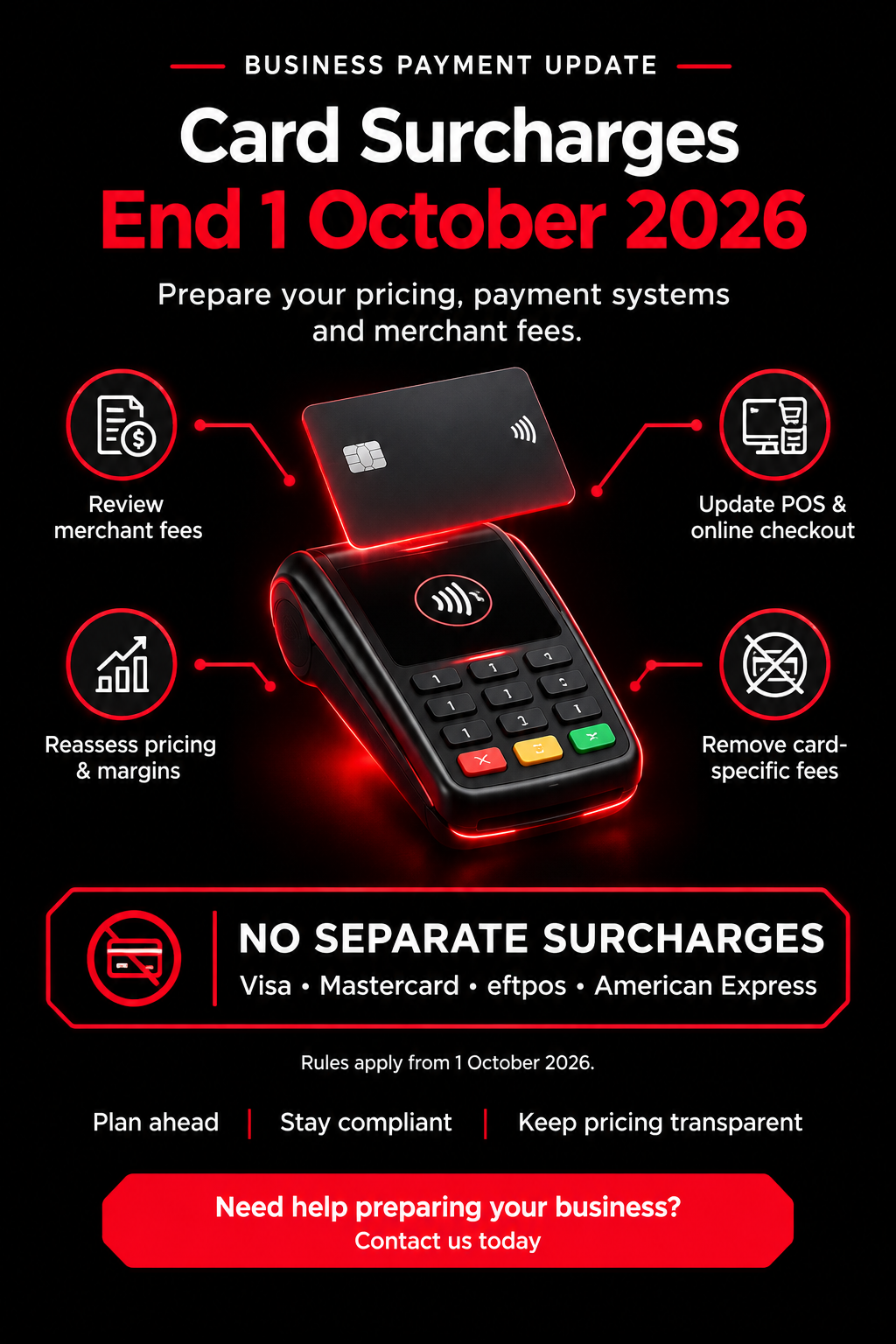
From 1 October 2026, Australian businesses will no longer be able to apply a separate surcharge when customers pay with Visa, Mastercard, eftpos or American Express cards.
The change is intended to make payment costs clearer and simpler for consumers. However, for many businesses that have used card surcharges to recover merchant fees, it means it is time to review pricing, payment processes and profit margins.
Until 30 September 2026, businesses may still charge a card surcharge, provided it does not exceed the actual cost of accepting that payment type and the business can substantiate those costs. From 1 October, this approach will no longer be permitted for the affected card networks.
Which payments are affected?
The new no-surcharge rules apply to payments made using:
- eftpos debit and prepaid cards
- Visa credit, debit and prepaid cards
- Mastercard credit, debit and prepaid cards
- American Express credit, debit and prepaid cards
This includes in-store terminal payments, online transactions, payment links and payments made through digital wallets where an eligible card is used.
Cash is not affected because it is not a card payment. Other payment methods, including BPAY, PayPal, Diners Club and taxi payments, may be subject to separate provider terms or regulatory arrangements.
Hospitality weekend and public-holiday surcharges are also generally unaffected, provided they are not charged specifically because the customer chooses to pay by card. Genuine booking or service fees may also continue where they apply independently of the payment method.
What this means for your business
For businesses currently adding a fee for card transactions, the cost of accepting payments will need to be managed differently.
Merchant fees will still exist. The difference is that they can no longer be passed on to customers as a separate card-payment charge for the covered networks.
Businesses may choose to:
- Absorb merchant costs as part of normal operating expenses
- Build card-processing costs into standard product or service pricing
- Review merchant-provider rates and payment-terminal arrangements
- Reassess margins, especially for low-value or high-volume transactions
- Review online checkout, invoice and recurring-payment systems
- Update customer-facing signage, payment terms and staff procedures
The right approach will vary depending on the industry, customer base, transaction volumes and current pricing model.
Prepare now
With the deadline approaching, businesses should begin preparing well before 1 October.
Start by reviewing your merchant statements and calculating what card payments currently cost your business across EFTPOS terminals, online payment gateways, invoice platforms and recurring-payment systems. Speak with your bank or payment provider to understand any new rates, terminal updates or automatic changes to surcharge settings.
It is also important to review every place a surcharge may appear, including point-of-sale terminals, website checkouts, payment links, invoices, email templates, terms and conditions, printed signage and staff scripts.
For example, a business that currently adds a 1.5% card surcharge may decide to remove the fee and instead make a small general pricing adjustment across its services. This can provide a simpler customer experience while helping the business recover part of its payment-processing costs.
Keep fees transparent
Businesses can still charge legitimate fees where appropriate, but they should ensure those charges are transparent, accurately described and not tied solely to a customer choosing to pay by card.
Simply renaming a card surcharge as an “administration fee,” “processing fee” or “service fee” will not make it compliant if the charge only applies to card payments.
Clear communication, updated systems and a considered pricing strategy will help businesses transition smoothly and avoid customer confusion.
Leave a Reply